CUSTOM

PEST CONTROL, LLC.

Termite and Pest Services


WE NOW HAVE

RealPlayer

Real Player required to watch termite video


Flash Plug In Required


Spider Problem?  Call a Specialist 894-3198

1-877-806-PEST (7378)

     Most spiders are small, inconspicuous arthropods which are harmless to humans.  Very few of the nearly 900 species of spiders in Alabama can hurt people. Only two groups--recluse spiders and widow spiders-- are considered poisonous to humans.

     Tarantulas, jumping spiders, wolf spiders and some other spiders worry people who mistakenly believe they are seriously poisonous. Although these spiders are often large, hairy and formidable-looking, their bite is typically less harmful than a bee sting. People who are extremely allergic to spider venom, though, react severely to any spider bite.

     Many people have a phobia of spiders. However, knowing how to distinguish harmless from dangerous spiders, how to prevent them from entering the home and how to control those that do enter can prevent needless concern and reduce the chances of harm to humans. 

 Click on the spider you wish to know about.

Brown Recluse  -  Black Widow  -  Wolf spiders  -  Orb weaver  -  House Spider

First Aid for Spider Bites

Recluse spiders     Back to top

Five species of recluse spiders have been recorded in Alabama: Loxosceles apachae, L. blanda, L. devia, L. reclusa and L. rufescens. Although only L. reclusa and L. rufescens have been recorded as venomous to people, it is best to consider all these species as potentially dangerous.

The best-known species, the brown recluse spider, Loxosceles reclusa, inhabits many Southern and Midwestern states. Recluse spiders are frequently found in garages, firewood piles, cluttered cellars and stored board piles. They often live around human dwellings, in bathrooms, bedrooms and closets, under furniture, behind baseboards and door facings, or in corners and crevices. Recluse spiders are most active at night when they hunt. People are sometimes bitten while asleep, apparently when rolling over on a spider while in bed. Others are bitten when putting on clothes that have hung undisturbed for a long time and where spiders are hiding.


Description and life cycle
As their name implies, recluse spiders are generally shy. They spin nondescript white or grayish webs, where they may hide during the day. They are predators of insects and other arthropods, known to wander around houses looking for prey. While walking, their body and legs together cover an area about the size of a quarter or half-dollar, but the body itself is only 1/4 to 1/2 inch long. Their color varies from orange-yellow to dark brown.

The brown recluse’s most distinguishing characteristics are its eye pattern and markings on the back. Recluse spiders have six eyes arranged in three pairs in a semicircle on the forepart of the head. Uncommon in spiders, this eye pattern helps separate recluse spiders from similar species. The eyes also form the base of a violin-shaped marking on the back. The neck of the “violin” forms a distinct, short median groove (see Figure 1). The violin marking may be conspicuous or blend with the background color.  Just because you can't distinguish the "violin" don't assume that the spider is not a brown recluse.

One other group of spiders, the spitting spiders, Scytodes, has a similar eye arrangement. A spitting spider has long, spindly, banded legs and a spotted pattern on its cephalothorax, the front body region. The cephalothorax is raised in spitting spiders but nearly flat in recluse spiders. Slow-moving, spitting spiders are common in window sills and considered harmless.

Brown recluse spiders lay one to two egg masses per year in dark, sheltered areas. Similar to those of many other spiders, recluse egg cases are round, about 5/8 inch (1.6 cm) in diameter, flat on the bottom and convex on top. After 24 to 36 days, an average of 50 spiderlings emerge from the egg case. Their slow development is influenced greatly by nutrition and environmental conditions.

Bite symptoms
The effects of a recluse spider bite may be immediate or delayed, depending on the amount of venom injected and the victim’s sensitivity. Sometimes hardly noticed at first, the bite later causes a stinging sensation that may include intense pain. Fever, chills, nausea, weakness, restlessness and/or joint pain occur within 24 to 36 hours. The bite also produces a small blister surrounded by a large congested and swollen area. The venom usually kills the affected tissue, which gradually sloughs away and exposes underlying tissues. The edges around the wound thicken, while the exposed center fills with dense scar tissue. Healing may take six to eight weeks, often leaving a scar, depending on the amount of venom injected and the reaction of the individual.  If you feel that you have been bitten by a brown recluse, it is advised to seek medical attention immediately.  This is the best defense against permanent scarring. 


Black Widow spiders  Back to top

The southern black widow, Latrodectus mactans, and its relatives live across the entire United States. Other widow species found in Alabama are the western black widow, L. hesperus; the northern black widow, L. variolus; and probably the brown widow, L. geometricus. Their coloration varies considerably. For proper identification, an expert may be needed to examine mature specimens.

Widow spiders are found in protected cavities outdoors. Around houses, they may live in privies, garages, cellars, furniture, shrubbery, ventilators, rain spouts, gas and electric meters and other undisturbed places. Widow spiders also may be seen in cotton fields and occasionally vegetable gardens.

Like most spiders, widow spiders are shy and retiring. People are bitten occasionally when they accidentally disturb a hidden spider or its web. To avoid hidden spiders, take care when putting on seldom-worn shoes or clothing.

Description and life cycle

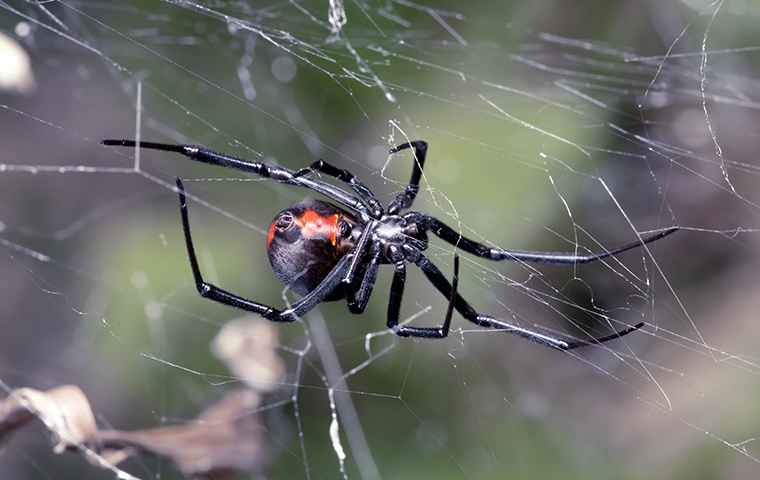
Widow spiders are typically jet black, but their color can vary considerably. Males and juveniles tend to show more color, with orange, red and white markings on the back and sides. On the underside of their rounded abdomen are two reddish triangles that may be united to form an hourglass shape.

Some individuals have irregular or spot-like markings; others have none at all. Adult widow spiders average 11/2 inches long and have eight eyes in two rows, a common spider pattern.

Females lay eggs in a loosely woven cup of silk. The 1/2-inch-long oval egg sacs hold from 25 to 900 or more eggs, which incubate for about 20 days, depending on temperature and time of year. Spiderlings usually stay near the egg sac for a few days after they emerge, when cannibalism is prevalent. Surviving spiderlings disperse by “ballooning.” They spin a single silk thread which is caught by the wind, which carries them to a new location. When about one-third grown, they establish themselves in a protected place and build loosely woven webs.

The spiders usually remain in their rather coarse, irregular, tangled webs for the rest of their lives. Over time they extend their webs and capture progressively larger prey. Males eventually leave their webs to find females for mating. Contrary to popular belief, most females do not normally eat the males after mating. This habit, found in a few species of widow spiders from other areas, gives the group its name.

Bite symptoms
If noticed at all, a widow spider bite may feel like a pin prick. Usually the bite location is indicated by a slight local swelling and two red spots surrounded by redness. The reaction is systemic and pain becomes intense in one to three hours, continuing for up to 48 hours. Symptoms include tremors, nausea, vomiting, leg cramps, abdominal pain, profuse perspiration, loss of muscle tone and rise in blood pressure. The toxin can also cause breathing difficulties and sometimes unconsciousness. However, less than 5% of people bitten by widow spiders die.


Other common spiders

Wolf spiders   Back to top

Wolf spiders hunt at night. Usually brown and black, they may have longitudinal stripes. Wolf spiders are large and often seen under lights. They can be seen at night when their eyes reflect light from a flashlight, headlamp or car headlight.

Members of the genera Rabidosa and Hogna are some of the most conspicuous wolf spiders. They form webbing only to provide daytime shelter, not to capture prey. Many wolf spider females carry their egg masses below their abdomens until after the eggs hatch. Young spiderlings cling to the mother’s abdomen for a short time after hatching. Wolf spiders frequently enter homes and backyards but pose no danger to people.


Orbweavers   Back to top

Orb-weaving spiders produce the familiar flat, ornate, circular webs usually associated with spiders. Orbweavers come in many shapes and sizes, but the brightly colored garden orbweavers, Argiope, are the largest and best-known. The yellow garden spider, Argiope aurantia, is marked with yellow, black, orange or silver. The female body is more than 1 inch long with much longer legs. It is also known as the black and yellow garden spider and sometimes the writing spider because of a thickened interwoven section in the web’s center. Male Argiope, often less than 1/4

the size of females, can sometimes be found in the same web with the female. Garden orbweavers are so named because their webs can be found in fields, on fences, around homes and in other locations.


Southern house spider   Back to top  


The southern house spider or crevice spider, Kukulcania hibernalis, frequently enters homes and causes concern when mistaken for a recluse spider. Southern house spider females are larger and darker brown than males. Larger than recluse spiders, they have eight eyes all in one cluster, and lack the recluse’s violin marking. This spider’s distinctive web can be recognized by webbing radiating outward from a central lair built in a hole or cavity. Southern house spiders are common in old barns and undisturbed buildings.


First aid for spider bites   Back to top

Relieve local swelling and pain by applying an ice pack, ammonia or alcohol directly to the bite area. In case of severe reaction, consult a doctor immediately and, if possible, take along the spider for positive identification. Specific antivenin is available to treat some widow spider bites.


*References and Pictures provided by Custom Pest Control, LLCt, Purdue University and Texas A&M University Entomology Dept.