
CUSTOM
PEST CONTROL, LLC.
Termite and Pest Services
|
|
|
|
|





Real Player required to watch termite video
1-877-806-PEST (7378)
common name: red imported fire ant
scientific name: Solenopsis invicta Buren (Insecta: Hymenoptera:
Formicidae: Myrmicinae)
Introduction - Distribution - Identification - Biology and Life Cycle
Introduction
Two species of fire ants are found in Alabama. Most notorious is Solenopsis invicta Buren, the red imported fire ant, followed by the much less common S. geminata (Fabricius), the tropical or native fire ant. Other more common U.S. members of this genus include S. xyloni McCook, the southern fire ant, and S. richteri Forel, the black imported fire ant, found in southeastern states.
Distribution
The red imported fire ant apparently was introduced in to the Mobile, Ala, or Pensacola, Florida, area from central Brazil between 1933 and 1945. Originally, it was believed to be the species, S. saevissima richteri Forel, with two color forms, red and black,. However, Buren (1972) described the black form to be a distinct species S.richteri Forel, which was different than the red form, S.invicta Buren. Literature prior to 1972 uses the older name. The black imported fire ant was apparently introduced before the red species around 1918 in the Mobile area. The black variety is confined to a much smaller range and now inhabits northeastern Mississippi, northwestern Alabama, and a small area in southwestern Tennessee (Vinson and Sorensen 1986).
Identification
The pedicel, or "waist" in the red imported fire ant
consists of two segments. Workers 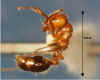 consist
of many sizes (polymorphic) between 2.4 to 6 mm (1/8 to 1/4 in). The
mandible has four distinct teeth and the antennae are 10-segmented, ending
in a two-segmented club. A sting is present at the tip of the gaster. Body
color is usually red to brown in color with a black gaster. (Click on
Picture for larger view)
consist
of many sizes (polymorphic) between 2.4 to 6 mm (1/8 to 1/4 in). The
mandible has four distinct teeth and the antennae are 10-segmented, ending
in a two-segmented club. A sting is present at the tip of the gaster. Body
color is usually red to brown in color with a black gaster. (Click on
Picture for larger view)
Mounds are built of soil and are seldom larger than 46 cm (18 in) in
diameter. When a 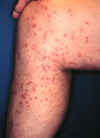 mound
is disturbed, ants emerge aggressively to bite and sting the intruder. As
seen in this picture, a white pustule usually appears the next day at the
site of the sting (Cohen 1992).
mound
is disturbed, ants emerge aggressively to bite and sting the intruder. As
seen in this picture, a white pustule usually appears the next day at the
site of the sting (Cohen 1992).
It is important to distinguish between the red imported fire ant and the native fire ant in order for appropriate control measures to be taken. Mounds of S. geminata will contain workers with square-shaped heads that are larger in proportion to the rest of their body. It is not suggested to get close enough to find this. If you feel that you have a problem then you can notify us at Custom Pest Control LLC. for proper pest identification.
Biology and Life Cycle
The lifespan of the red imported fire ant worker depends on their size. Minor workers may live 30 to 60 days, media workers 60 to 90 days, major workers 90 to 180 days, and queens may live two to six years. Complete lifecycle from egg to adult takes between 22 and 38 days (Hedges 1997).
Swarming or mating flights are the primary means of colony reproduction, secondarily, budding can occur in which a portion of a colony becomes an autonomous unit. After the colony reaches one year of age, reproductive alates also called swarmers are produced. Six to eight mating flights consisting of up to 4,500 alates each occur between the spring and fall. Mating flights usually occur midday on a warm (>74�F/24�C), sunny day following rain. Mating occurs during flight and the males die soon after mating with females. In the southern United States, as many as 97,000 queens may be produced per acre of infested land per year. Alates are often attracted to swimming pools where homeowners can find thousands of winged ants trapped on the water's surface (Hedges 1997).
After mating flights occur, it is common to find newly-mated queens clustered together under shelter. This clustering and the cooperation of the newly-mated queens aid in establishing a colony. However, as the colony grows all but one queen will be killed, except in the instance of multiple queen colonies.
Once the female alate has mated, she will rake her legs forward to snap her wings off at the basal suture and find a suitable spot to begin a new colony. Often this spot is under rocks, leaves or in a small crack or crevice, such as at the edge of a sidewalk, driveway, or street. The queen will burrow into the soil to excavate a small chamber, which is sealed off to keep predators out. Within 24 hours of mating, the queen will have laid between 10 to 15 eggs, which will hatch in eight to 10 days. By the time the first group of eggs hatch, the queen will have laid from 75 to 125 more eggs. The larval stage typically lasts six to 12 days and the pupal stage for nine to 16 days. The newly-mated queen will stop laying eggs until the first batch of workers mature. This process takes from two weeks to one month. The queen will feed the first batch of young larvae oils regurgitated from her crop, trophic eggs or secretions from her salivary glands. The queen's wing muscles, which are no longer needed, break down to provide the nutrients for the young larvae.
The first group of workers to emerge are characteristically small due to the limitations in nutrients that the queen provides. These workers, termed "minims," burrow out of the chamber and begin foraging for food to feed the queen and new larvae. The minims also begin construction of the mound. Within one month, larger workers are being produced and the mound is growing in size. By six months the colony has reached several thousand workers and the mound can be seen in a field or lawn. Colonies of this size generally contain a few large workers (major workers), many medium sized workers (media workers), and a majority of small workers (minor workers). The three types of workers are all sterile females and serve to perform tasks necessary to maintain the colony. The queen is the single producer of eggs and is capable of producing as many as 1,500 eggs per day. Mature red imported fire ant colonies may contain as many as 240,000 workers with a typical colony consisting of 80,000 workers.
The diet of foraging workers consists of dead animals, including insects, earthworms, and vertebrates. Workers also collect honeydew and will forage for sweets, proteins, and fats in homes. They are sometimes attracted to piles of dirty laundry. Larvae are fed only a liquid diet until they reach the third instar. When the larvae reach the fourth instar, they are able to digest solid foods. Worker ants will bring solid food rich in protein and deposit it in a depression in front of the mouth of the larvae. The larvae will secrete digestive enzymes that break down the solid food and regurgitate it back to worker ants. The queen is fed some of the digested protein to support egg production. As long as food is plentiful, egg production is at its maximum.
The sting of the red imported fire ant possesses venom of an alkaloid
nature, which 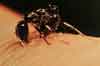 exhibits potent
necrotoxic activity. Approximately 95% of the venom is composed of these
alkaloids, which are responsible for both the pain and white pustule or
blisters that appears approximately one day after the sting occurs. The
remainder of the venom contains an aqueous solution of proteins, peptides,
and other small molecules that produce the allergic reaction in
hypersensitive individuals. Worker fire ants will attach to the skin using
their mandibles and will subsequently lower the tip of the gaster to
inject the stinger into the victim. Thus, fire ants both bite and sting,
but only the sting is responsible for the pain and pustule. This
sting can be painful for an adult, but can be deadly for a child or those
who may have an anaphylactic allergic reaction to the toxin. Control
is best achieved with a regular maintenance program from Custom Pest
Control, LLC by calling 256-894-3198.
exhibits potent
necrotoxic activity. Approximately 95% of the venom is composed of these
alkaloids, which are responsible for both the pain and white pustule or
blisters that appears approximately one day after the sting occurs. The
remainder of the venom contains an aqueous solution of proteins, peptides,
and other small molecules that produce the allergic reaction in
hypersensitive individuals. Worker fire ants will attach to the skin using
their mandibles and will subsequently lower the tip of the gaster to
inject the stinger into the victim. Thus, fire ants both bite and sting,
but only the sting is responsible for the pain and pustule. This
sting can be painful for an adult, but can be deadly for a child or those
who may have an anaphylactic allergic reaction to the toxin. Control
is best achieved with a regular maintenance program from Custom Pest
Control, LLC by calling 256-894-3198.
*References and Pictures provided by Custom Pest Control, LLC, Mallis Hand Book, Purdue University and Texas A&M University Entomology Dept