
CUSTOM
PEST CONTROL, LLC.
Termite and Pest Services
|
|
|
|
|





Real Player required to watch termite video
1-877-806-PEST (7378)
Common name: Argentine Ant
Scientific Name: Linepithema humile (Iridomyrmex humilis)
Introduction - Distribution - Identification - Biology and Life Cycle
Introduction
This ant probably first arrived in the U.S. at the Port of New Orleans in the 1890s. It is believed to have traveled on coffee
boats from Brazil, not Argentina. It was originally known as the New
Orleans ant but the city leaders objected and the name was changed.
of New Orleans in the 1890s. It is believed to have traveled on coffee
boats from Brazil, not Argentina. It was originally known as the New
Orleans ant but the city leaders objected and the name was changed.
Argentine ants are small ants. They are often present in great numbers and may form long lines. They forage 24 hours a day. Workers are all one size although a larger queen may occasionally be seen foraging in the open. Queens are 2 to 4 times as large as workers and are grayish brown in color. Winged males may also be present in lines of foragers. Argentine ants are identified by the following characteristics: The thorax lacks spines. The pedicel is a single segment and visible when the ant is viewed from above. Unlike most ants, the Argentine ant has no worker caste, so all the ants except the queen are the same size. So if you see a trail of ants that are small and dark in color and are all the same size, this is most likely the Argentine ant.
Distribution
Argentine ants live in super-colonies, nests that may contain hundreds of queens and millions of workers and cover several city blocks. During cold weather the ratio of workers to queens is much lower than in summer months. Like all ants, this species has a complex life cycle developing from eggs into white legless larvae and pupae before emerging as adults. Development from egg to pupa takes place within the nest and immatures are rarely seen. Queens and drones mate within the nest. Only the drones emerge and fly away and probably die without mating again. Swarms of males occur between dusk and dawn and are rarely seen. When queens disperse, it is on foot accompanied by an escort of workers.
The Argentine ant is now permanently established in Alabama and other parts of the southern United States, including Georgia and Florida. These ants are most commonly encountered in urban areas and along the coast. Argentine ants are usually found on trees or shrubs, in flowerbeds, in and around mulch, and in trash heaps. In the summer these ants live in shallow nests under mulch, refuse, or the roots of a tree or shrub. Occasionally, Argentine ants actually nest on the surface of the soil. In cold weather, they withdraw into deeper central nests, foraging whenever the weather allows. Argentine ants prefer to nest outdoors but, in areas outside their normal range, will sometimes nest in structures, frequently in the hollow areas of plumbing fixtures or in houseplants
Identification
.Size: Workers of this species are about 1/8-inch in length.
Color: Varies from dark brown to black, and the body is often
shiny in appearance.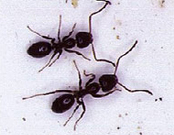
The colonies of Argentine ants can grow quite large and contain tens of
thousands of workers and numerous queens. Each colony will be divided into
sub colonies located in various suitable harborages connected by
established trunk trails. These sub colonies will number anywhere from a
few hundred to a few thousand individuals.
Color: Ranges from black to dark brown to red and black. The
smaller species are typically uniformly dark in color. A larger species,
common in Texas, is red and black.
Biology and Lifecycle
The colony may have hundreds of queens, and each
colony will be divided into a number of sub colonies. Since members of two
separate colonies are not aggressive toward each other, colonies will
often combine with one another. This creates huge super-colonies that may
extend over several properties. Argentine ants have been know to
forage up to 300 yards away from the main colony. Argentine
ants are very aggressive and will drive out native species of ants. Their
primary food source during the warm months is the sweet honeydew produced
by aphids. The presence of fruit trees, roses and other plants that
attract aphids often contributes to Argentine ant infestations. They are
also known to be attracted to the inside of a home after a recent rain
storm and like to follow the hot water lines in the home.
Argentine ants reside outdoors, usually in shallow nests in the soil
beneath a stone, board or any other item that provides protection. Small,
medium or large sub colonies will locate themselves in piles of lumber,
bricks or debris; in landscape mulch; behind brick and stone veneer;
within and under insulation; and in wall voids or any other suitable void.
Argentine ants are the most common invaders of homes in Alabama. This ant
is also very common in homes throughout most of the Gulf Coast states.
*References and Pictures provided by Custom Pest Control, LLC, Mallis Hand Book, Purdue University and Texas A&M University Entomology Dept